
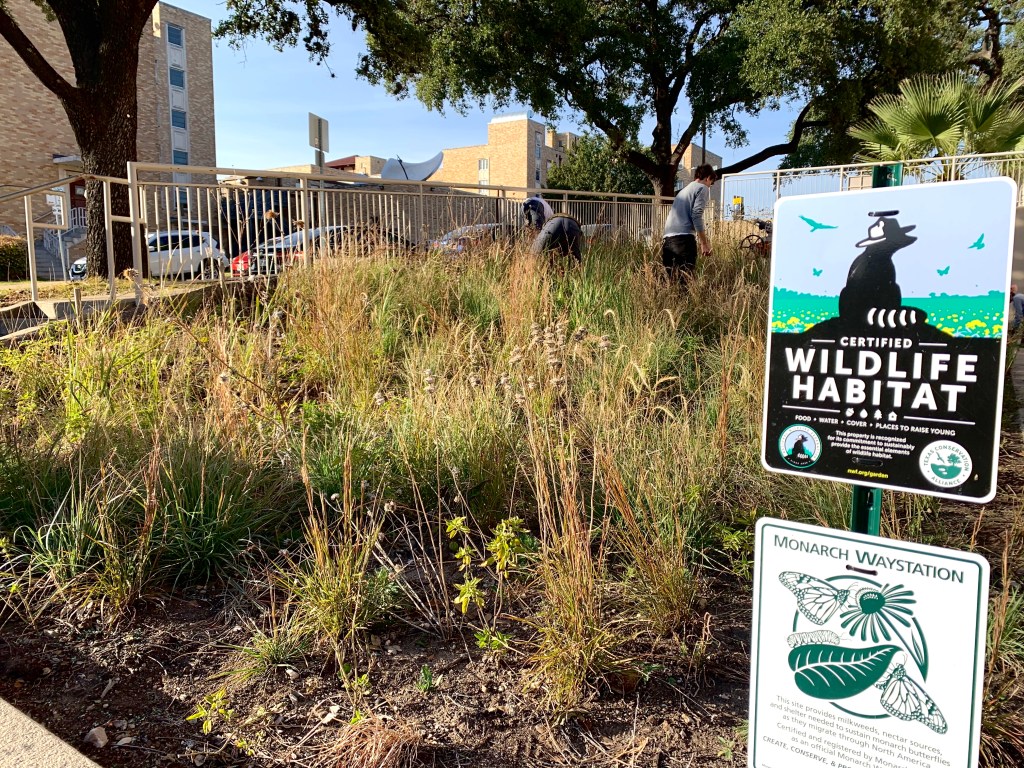
What is the Little Blue Prairie?
Little Blue Prairie (formerly Half-Pint Prairie) is a pocket of recreated Blackland prairie habitat located west of the Student Services Building.
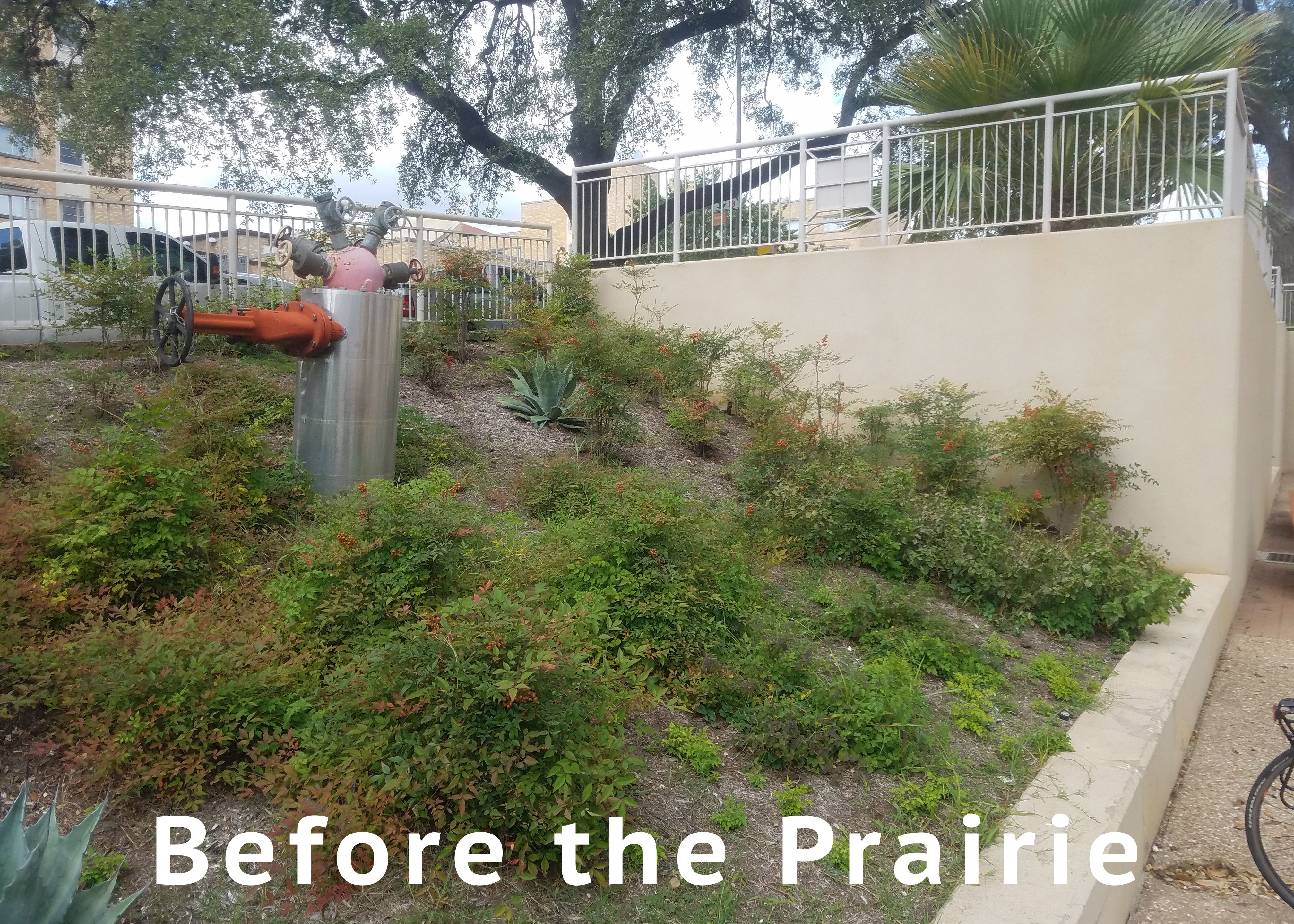



Blackland prairies are an endangered ecosystem in what is now known as Texas. They once covered much of the state, from north of San Antonio all the way to the Red River. However, today, less than 0.1% of the prairie remains.
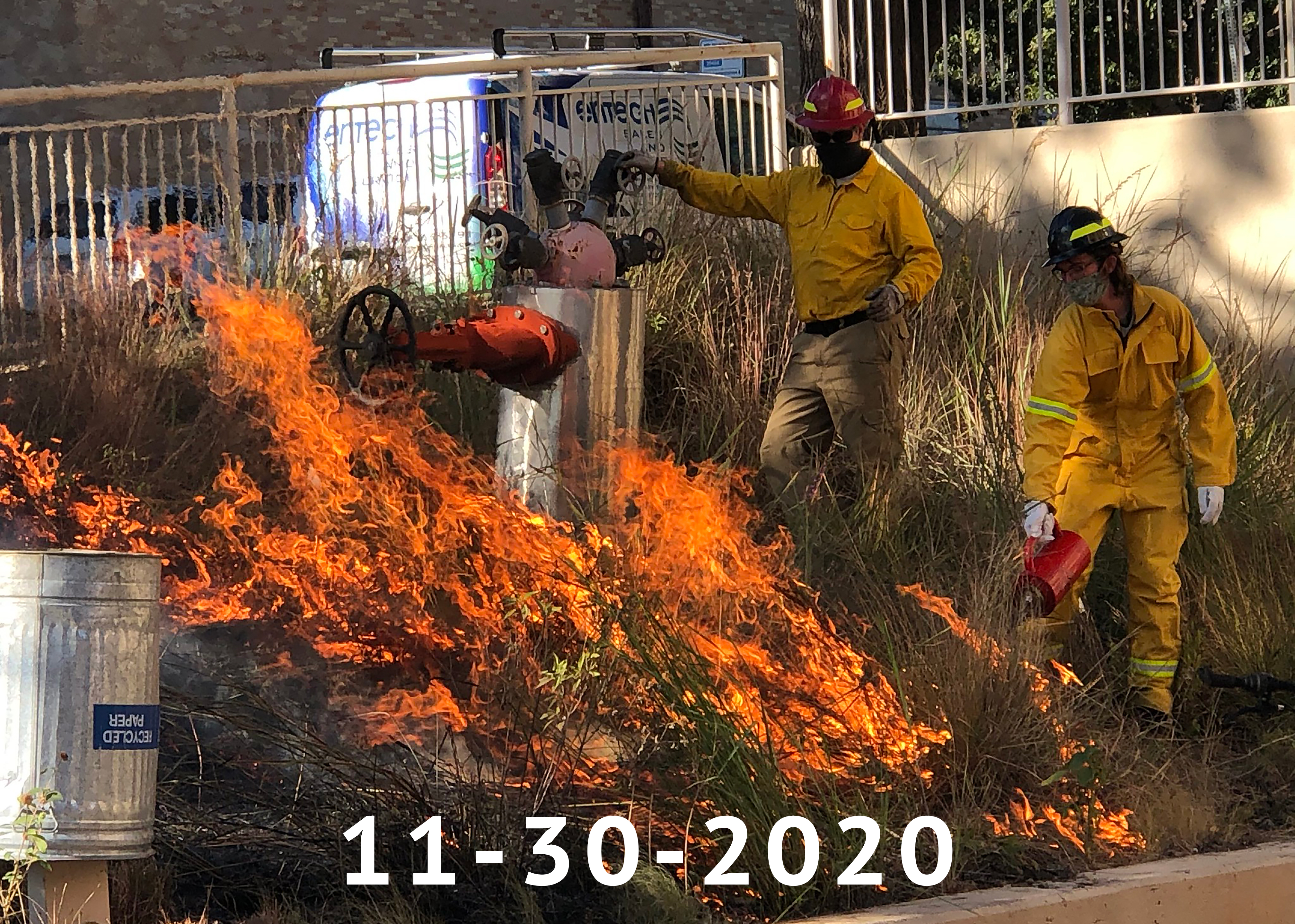
The invasion of land that belongs to the Wichita, Tonkawa, Pamaya, Caddo, Comanche, Coahuiltecan, and others by settlers catalyzed this loss of land. European settlers sought to destroy the relationship that sustained both people and prairie through forced displacement. With the removal of Indigenous people, the periodic burns and cyclical buffalo grazing necessary for a healthy prairie were suppressed.
In the following centuries, the settlers new to this land overgrazed the grasses, converted diverse prairies into monoculture crops, and built cities dependent upon extractive industries.
We do not believe that we can approach the phenomena of ecological destruction through merely an environmental lens. The Little Blue Prairie is an attempt to capture a fraction of the plant biodiversity that would have been in this region. Through controlled burns, we hope to honor and recreate ecological processes that historically moved through this landscape before suppression. See Our Controlled Burns
Our work includes:
- Challenging norms around traditional landscaping: The typical green, turfgrass front yard has to go. They separate us from the land by perpetuating unrealistic notions about what our local environments look like.
- Enabling others to forge their own relationships with local ecologies: Observing plants is an opportunity to practice mindfulness, connect with the soil, and engage in a healing process for both you and the Earth.
- Providing accessible environmental programming: Discussions about the environment should be centered on peoples’ lived experiences, not economic production or inaccessible -ologies.
In Fall 2021, the Little Blue Prairie project was institutionalized under UT Grounds and Landscaping. As of Fall 2024, it is co-managed with the UT Microfarm. Please reach out to Landscaping or Microfarm with ideas, questions, or collabs.
Plant Species List
| Scientific Name | Common Name |
| Abutilon fruticosum | Texas Indian-mallow |
| Bouteloua curtipendula | Sideoats grama |
| Callirhoe involucrata | Winecup mallow |
| Chasmanthium latifolium | Inland sea-oats |
| Cocculus carolinianus | Carolinia snailseed |
| Desmanthus illinoensis | Illinois bundleflower |
| Dracopis amplexicaulis | Clasping coneflower |
| Eriogonum longifolium | Longleaf buckwheat |
| Helianthus annuus | Common sunflower |
| Helianthus maximiliani | Maximilian sunflower |
| Liatris punctata | Blazing star |
| Malvaviscus arboreus var. drummondii | Drummond’s wax mallow |
| Marshallia caespitosa | Barbara’s buttons |
| Palafoxia rosea | Rosy palafox |
| Penstemon cobaea | Prairie penstemon |
| Plectocephalus americanus | American basket-flower |
| Salvia farinacea | Mealy blue sage |
| Schoenocaulon texanum | Texas Feathershank |
| Setaria sp. | Bristlegrass |
| Solanum elaeagnifolium | Silverleaf nightshade |
| Vicia ludoviciana | Louisiana vetch |


 Campus Environmental Center